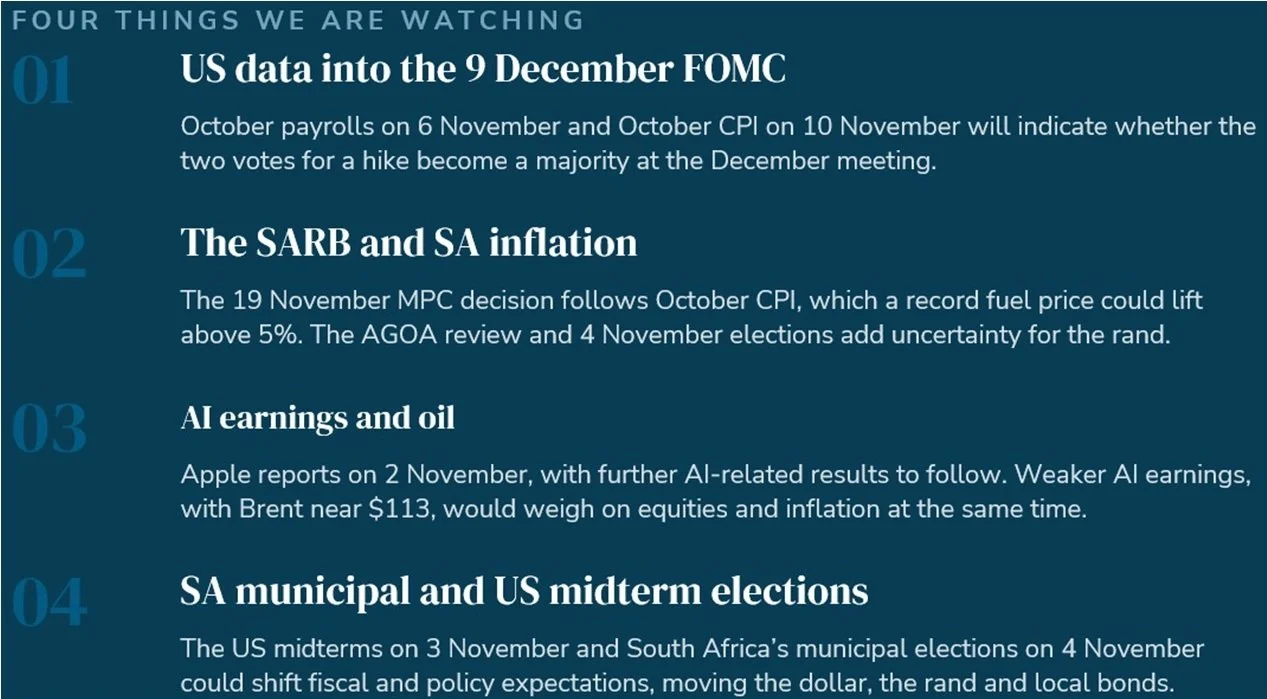
A shift away from AI stocks reinforced the case for diversified portfolios amid persistent inflation.
01 MACRO OVERVEW
Central banks held rates while markets adjusted
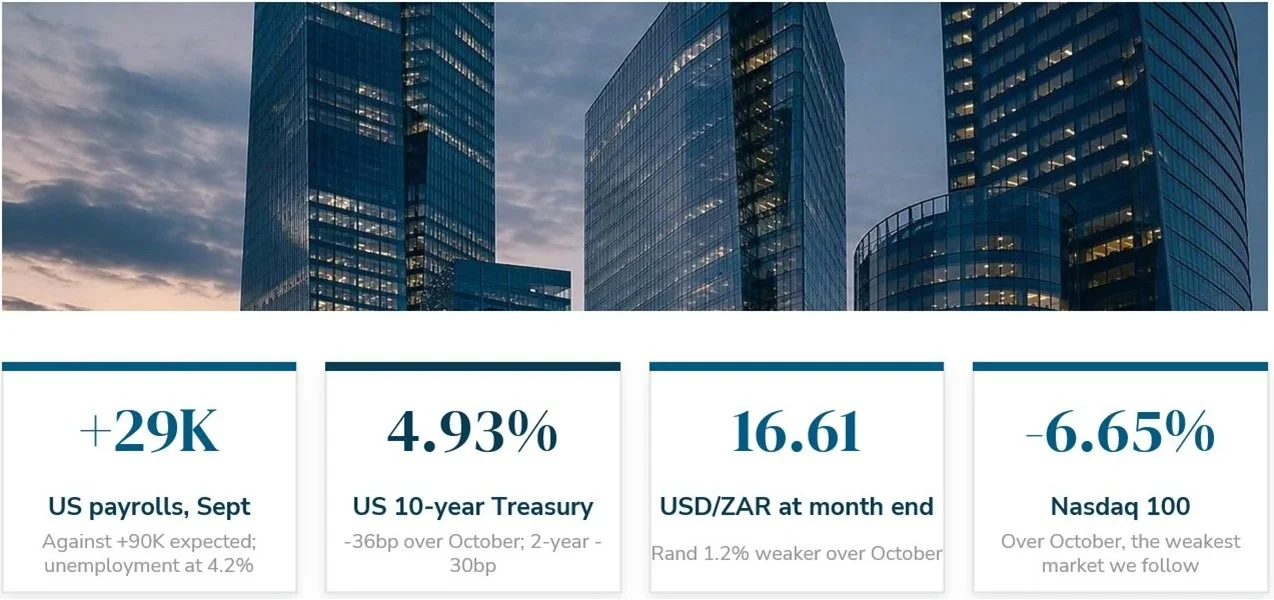
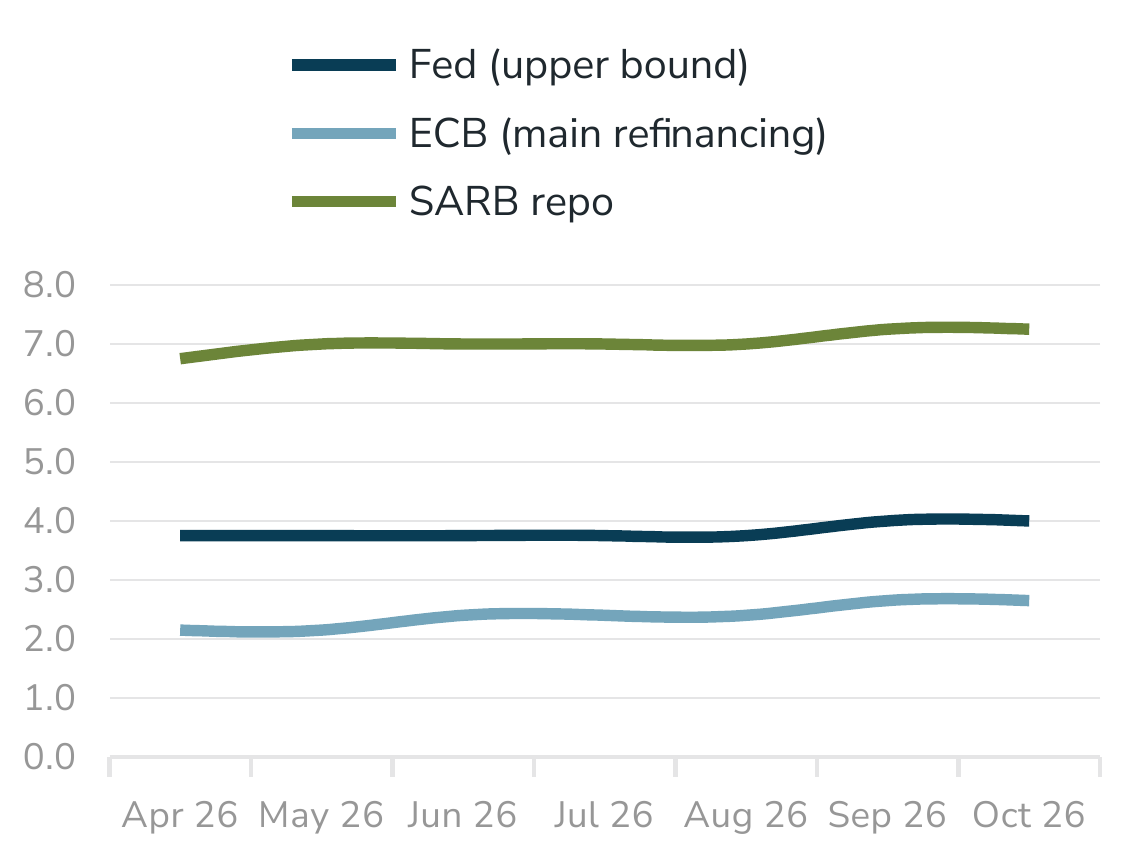
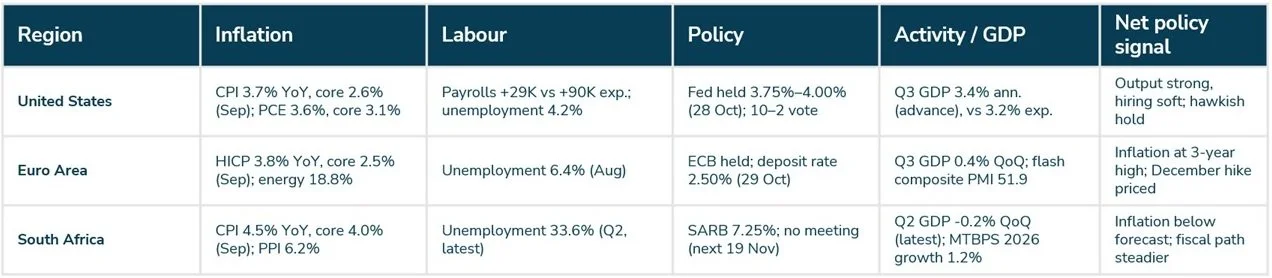
The Fed, the ECB and the SARB all left rates unchanged in October, though none indicated that tightening has ended. The Fed held its range at 3.75%–4.00% on 28 October in a 10–2 vote, with both dissenting members preferring a hike. The ECB held its deposit rate at 2.50% the next day after discussing an increase. The SARB did not meet, and its next decision is on 19 November.
The economic data pointed in different directions. US payrolls rose by only 29,000 in September, against about 90,000 expected, and unemployment rose to 4.2%. Inflation kept rising: US CPI reached 3.7% and euro-area inflation 3.8%, driven mainly by energy, with Brent closing the month near $113. South Africa was the exception, with inflation of 4.5% coming in below forecast.
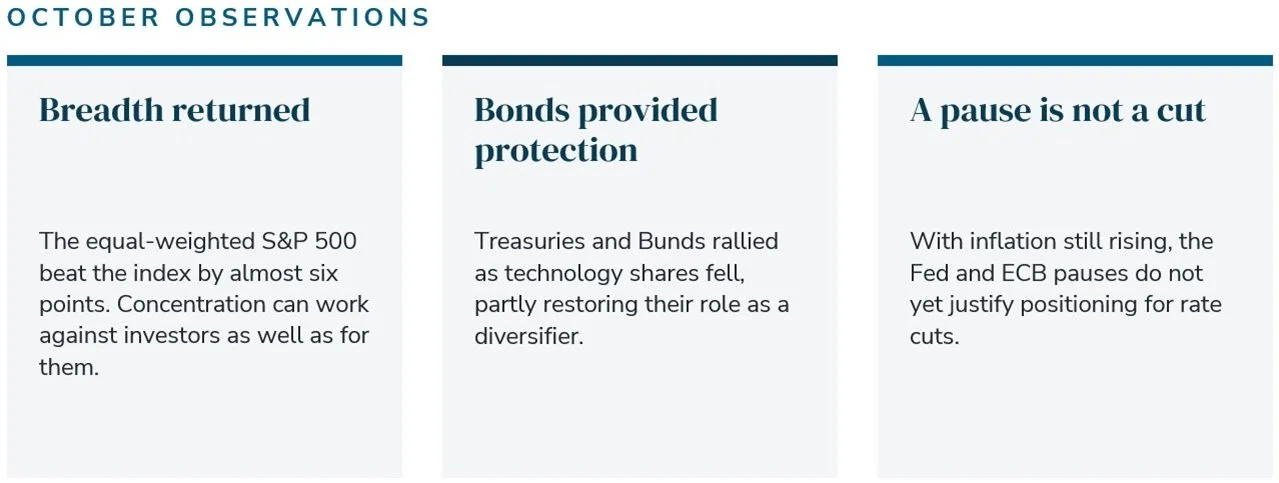
Markets saw renewed volatility. Concerns about the return on AI investment saw the Nasdaq 100 fall 6.65%, while the equal-weighted S&P 500 rose 4.9% and the DAX 2.46%. Bonds rallied as investors looked for safety. The US 10-year yield fell 36 basis points to 4.93%, its largest monthly decline since December 2023, and the Bund yield 24 basis points to 3.34%.


02 MARKET PERFORMANCE
Market gains broadened beyond AI
Developed-market equities - October 2026, rebased to 100 at 30 Sep
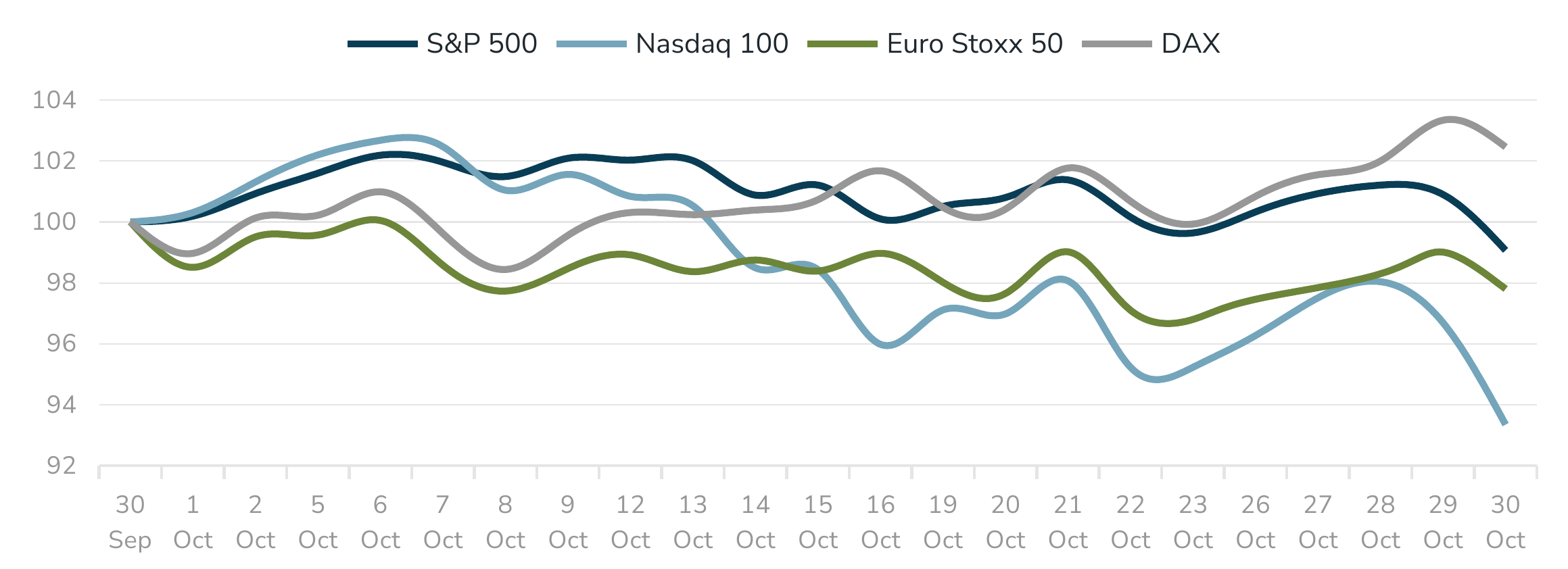
Source: Douglas Investments research and LSEG. Price returns in local currency, rebased to the 30 September 2026 close.
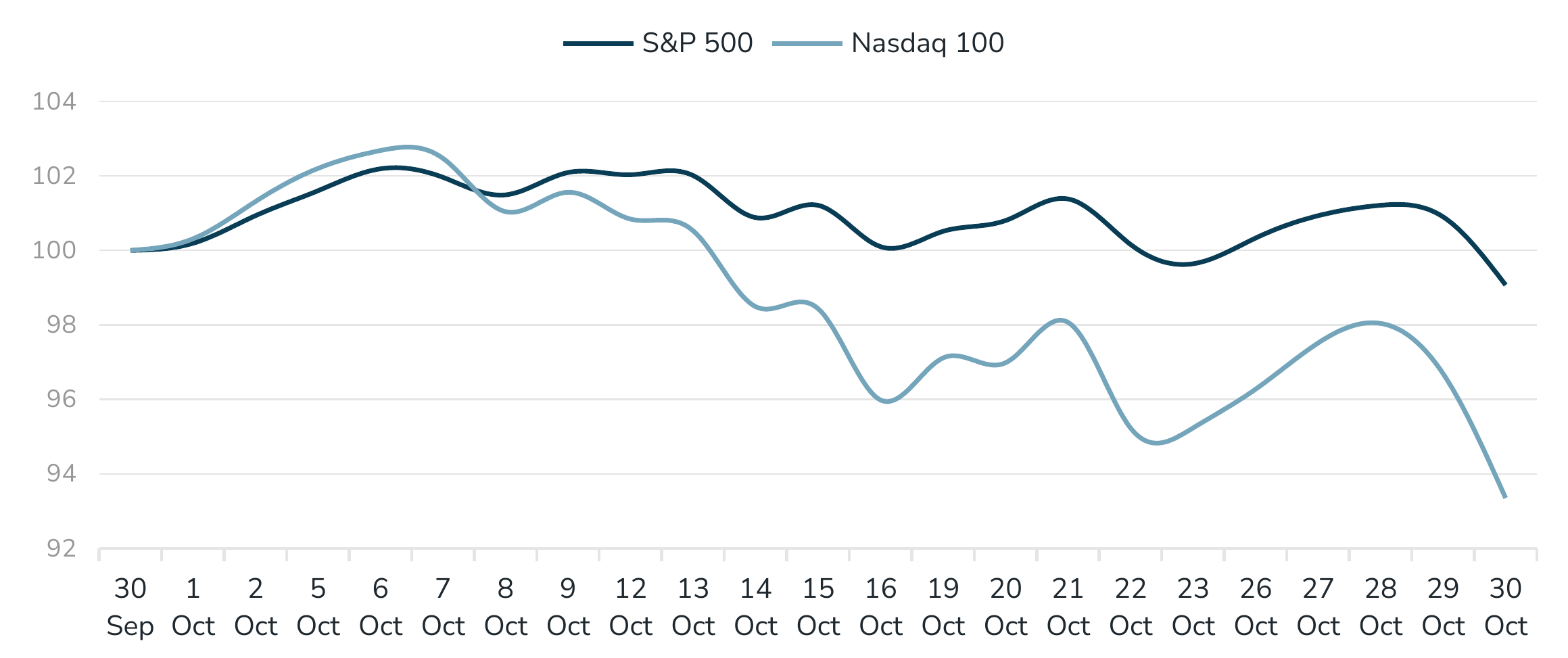
October unfolded in three stages. The first week built on September’s rally, with the S&P 500 and Nasdaq 100 reaching record closes on 6 October. Higher-than-expected US inflation on 14 October and weakness in semiconductor shares then weighed on technology. Company results shaped the rest of the month: Meta’s spending guidance on 22 October and results from Amazon and Intel on 30 October renewed questions about the return on AI investment.
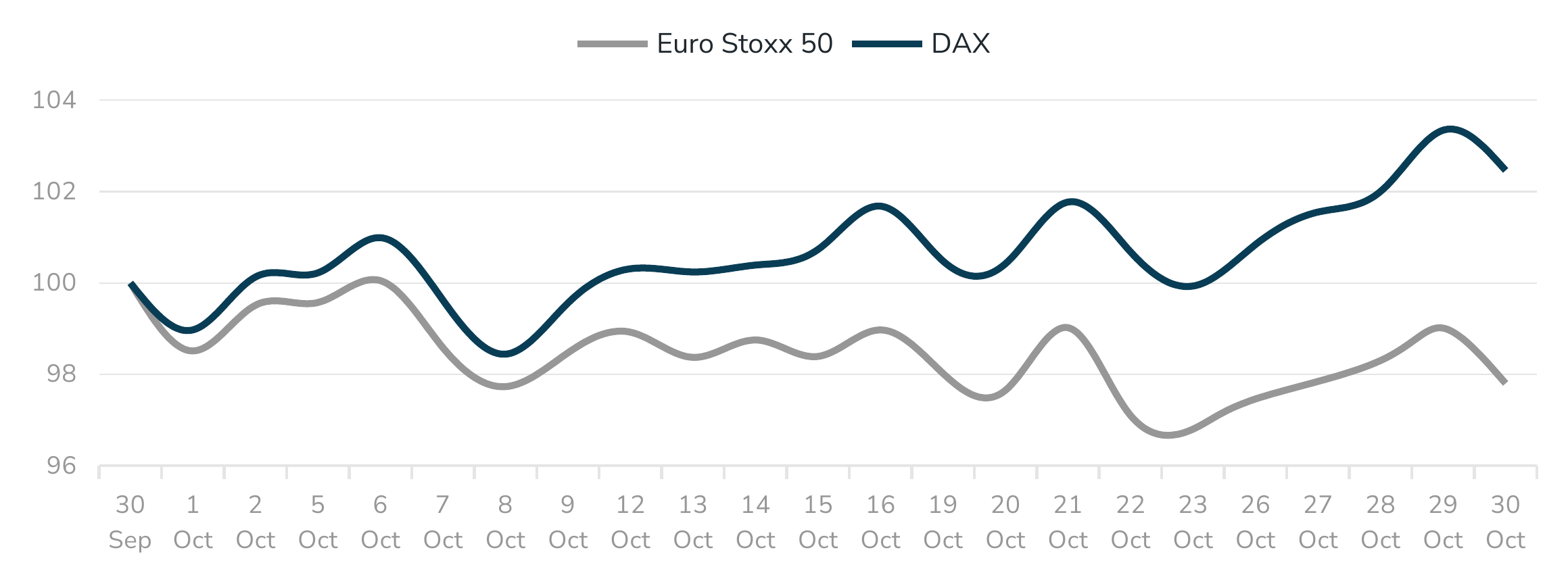
Returns depended largely on what each index holds. The DAX rose 2.46%, while the Euro Stoxx 50 fell 2.20%, the S&P 500 0.93% and the Nasdaq 100 6.65%. The JSE All Share eased 0.82%, recovering mid-month before falling 2.20% on the final day as precious metals and global technology shares weakened.
JSE All Share October 2026, rebased to 100 at 30 September close
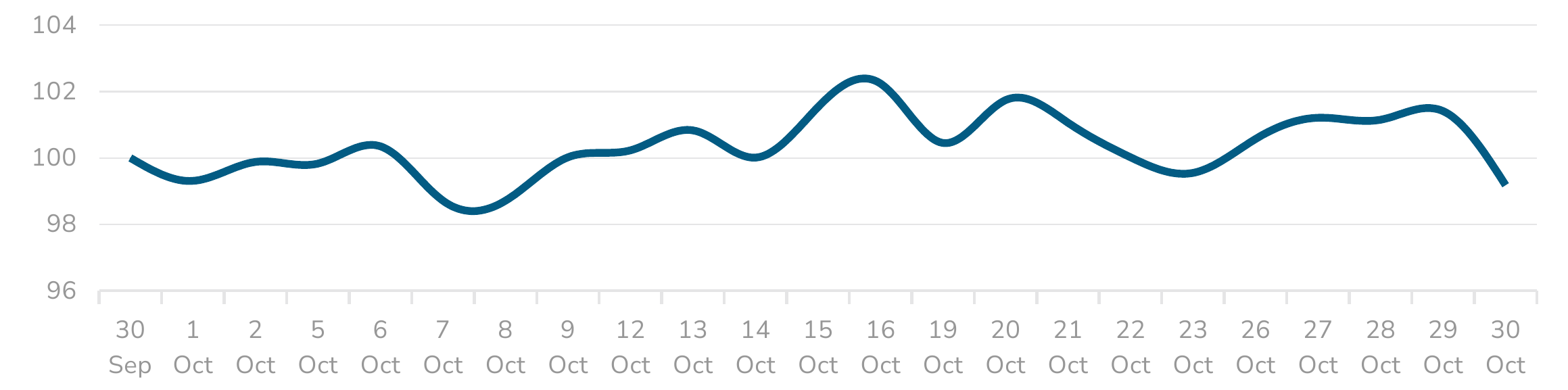
Source: Douglas Investments research and LSEG. Price returns in local currency, rebased to the 30 September 2026 close.
Around nine percentage points separated the DAX and the Nasdaq 100. In October, balance across sectors mattered more than any single regional view.
03 POLICY & INFLATION
Inflation continued to rise, but central banks chose to wait
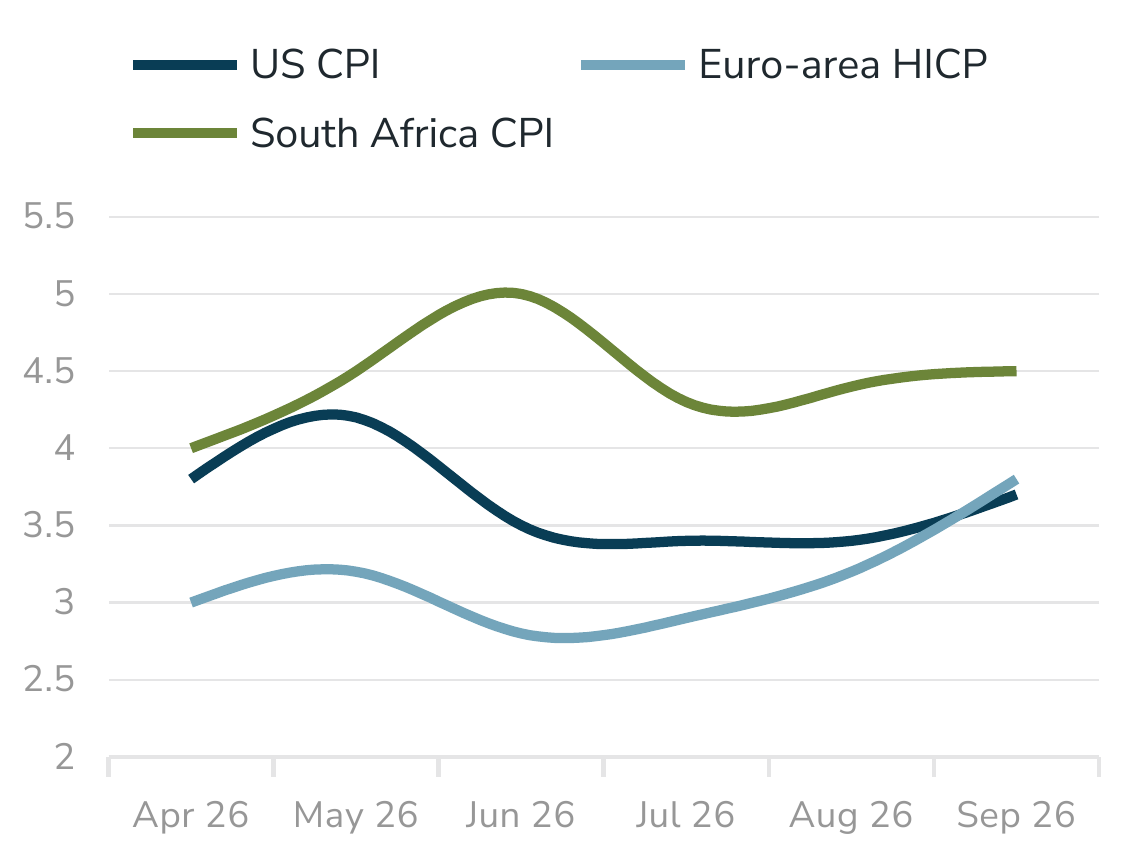
Headline inflation % year on year, 2026
Source: Douglas Investments research and LSEG. Inflation shown to September, the latest full set of prints; policy rates to end-October.
Policy rates %, month end, 2026
Source: Douglas Investments research and LSEG. Inflation shown to September, the latest full set of prints; policy rates to end-October.
Headline inflation rose again in all three regions. US CPI reached 3.7% in September, up from 3.4%, with gasoline prices 34.2% higher than a year earlier. Euro-area inflation rose to 3.8%, its highest since September 2023, with energy up 18.8%. South African CPI rose slightly to 4.5%, below the 4.7% expected, although a record fuel price in October may lift the next reading above 5%.
Core inflation is more contained: US core CPI was 2.6%, euro-area core 2.5% and South African core 4.0%. This gave policymakers room to wait. The Fed held at 3.75%–4.00% with two members voting for a hike, and the ECB held at 2.50% after discussing one, with Lagarde seeing no evidence yet of further second-round effects. Futures markets still lean towards December hikes from both.
October changed the timing of tightening, not its direction. With headline inflation still rising, a pause gives central banks time to assess the data; it is not yet a sign of easing.
04 DATA SURPRISES
Hiring fell short of forecasts while inflation edged above them
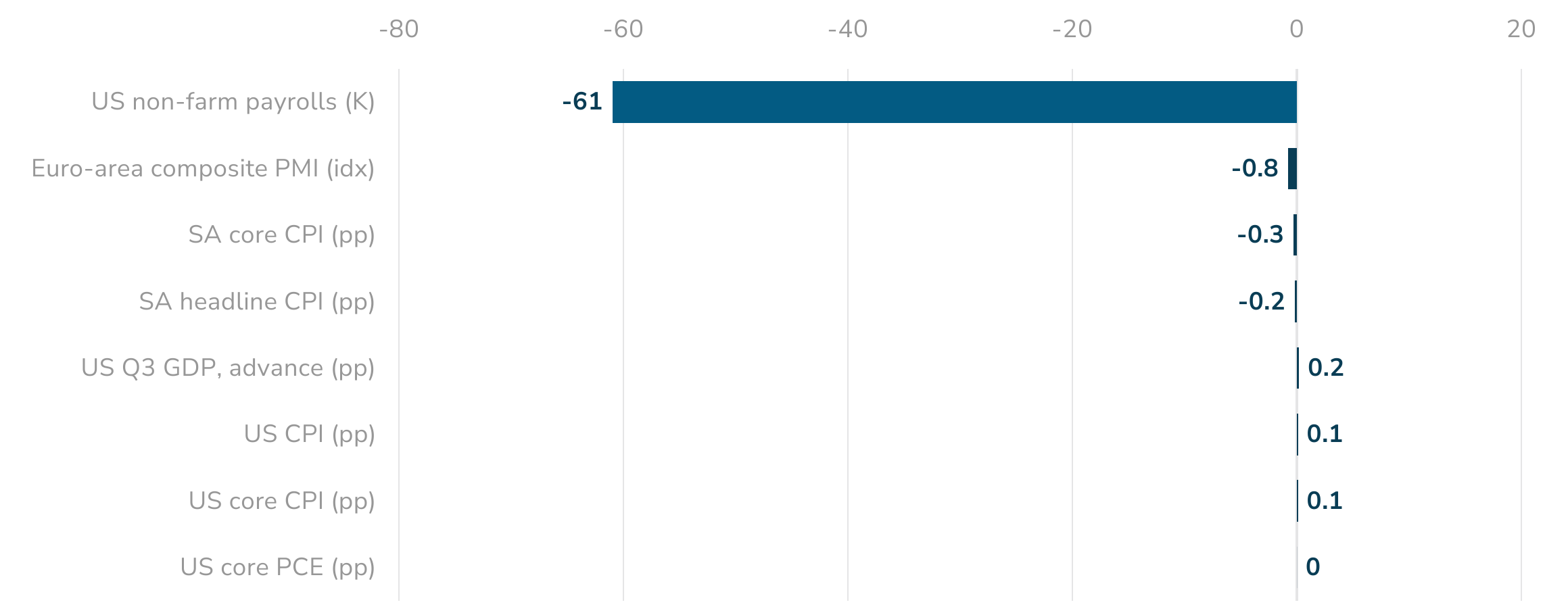
Largest surprises versus consensus October 2026 releases, actual less consensus
Source: Douglas Investments research and LSEG.
October’s surprises followed a clear pattern: activity data was mixed, while prices ran slightly ahead of expectations. US payrolls rose by 29,000 in September against a FactSet median of 90,000, July and August were revised down by a combined 60,000, and wage growth slowed to 3.0%. Third-quarter GDP, by contrast, grew 3.4% annualised against 3.2% expected, while the euro-area flash composite PMI fell to 51.9, 0.8 points below consensus.
NOTE: The measures are not directly comparable. Payroll surprises are in thousands of jobs, GDP and price data in percentage points, and PMIs in index points.
In the United States, inflation surprises were small but pointed the same way. September CPI was 3.7% against 3.6% expected, and core 2.6% against 2.5%, driven by a 9.1% monthly rise in gasoline prices. September PCE inflation, released on 29 October, was in line at 3.6% headline and 3.1% core. South Africa was the clear exception: headline CPI of 4.5% was 0.2 points below the 4.7% consensus and core inflation of 4.0% was 0.3 points below forecast, which reduces the near-term case for a further SARB hike.
Softer hiring, firm growth and persistent inflation gave central banks reason to wait, and bond markets reason to rally.
05 RATES & CURRENCIES
Bond yields fell markedly as the rand and euro weakened
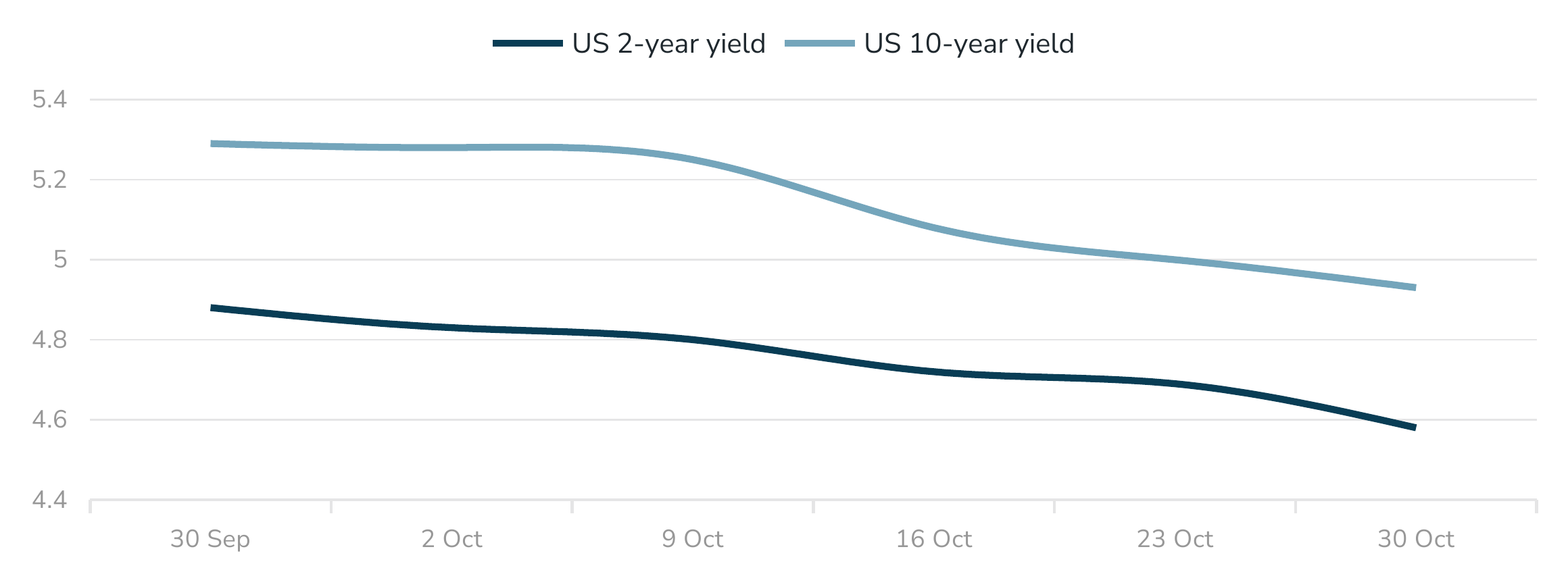
US Treasury yields %, weekly closes, October 2026
Source: Douglas Investments research and LSEG.
The dollar was broadly steady over the month, while the euro and the rand weakened. EUR/USD eased about 1% to near 1.12 after touching its lowest level since May 2025. The rand weakened about 1.2% to 16.61, affected by a firmer dollar early in the month and softer gold and platinum prices later on.
Bond yields fell across developed markets, reversing much of September’s rise. The US 10-year yield fell 36 basis points to 4.93%, its largest monthly decline since December 2023, and the two-year 30 basis points to 4.58%, after the 10-year reached its highest level since 2002 early in the month. The Bund yield fell 24 basis points to 3.34%, and gilts were steady after the 28 October Budget. The move reflected softer hiring, demand for safety and central-bank pauses, rather than lower inflation.
USD/ZAR October 2026, rand per US dollar, daily
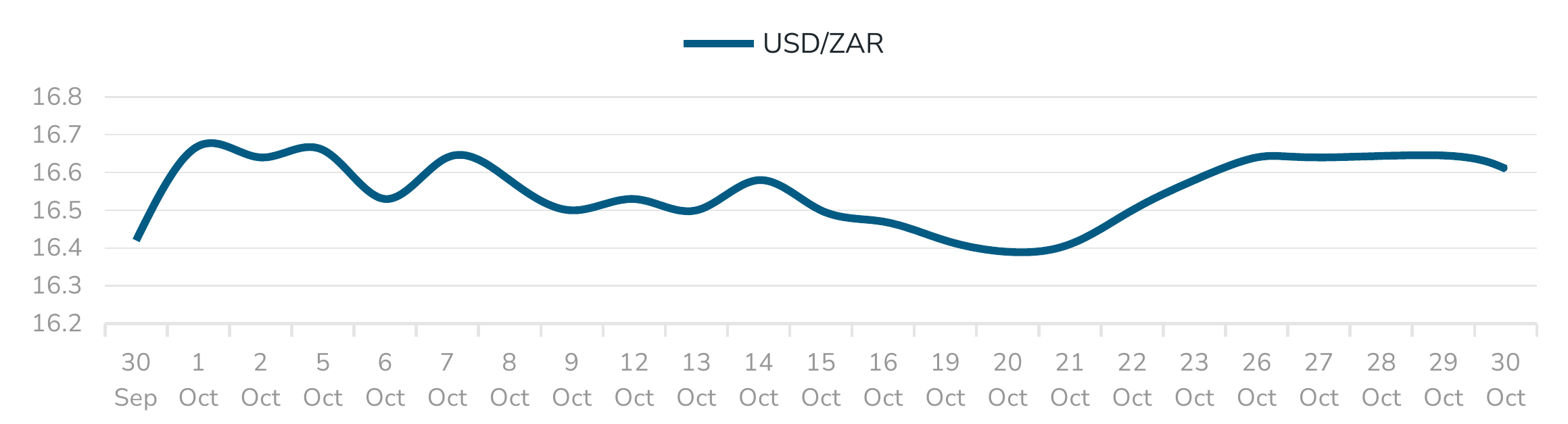
For rand-based investors, lower global yields strengthen the case for longer-dated offshore bonds, while a slightly weaker rand added to the rand value of offshore assets in October.
06 UNITED STATES
Strong growth, softer hiring and a divided Fed
S&P 500 and Nasdaq 100 October 2026, rebased to 100 at 30 Sep
Source: Douglas Investments research and LSEG

At 4.93%, the 10-year yield offers an attractive starting point for high-quality bonds, with less term-premium pressure than in September. October showed how quickly concentrated AI leadership can reverse, and we believe sector breadth should carry weight in portfolios.
07 EUROPE & THE UNITED KINGDOM
Inflation at a three-year high as growth slows and the ECB waits
Euro Stoxx 50 and DAX October 2026, rebased to 100 at 30 Sep
Source: Douglas Investments research and LSEG. Price returns in local currency, rebased to the 30 September 2026 close.
Euro-area inflation rose to 3.8% in September from 3.2%, its highest since September 2023, with energy prices 18.8% higher, core at 2.5% and services at 3.2%. Growth slowed: third-quarter GDP rose 0.4% quarter on quarter after 0.6%, with France contracting 0.1%, Italy flat and Germany up 0.2%, and the October flash composite PMI fell to 51.9 from 53.1. The ECB held its deposit rate at 2.50% on 29 October after discussing a hike, and Lagarde announced that she will step down in February 2027.
Equity markets diverged: the DAX rose 2.46%, while the Euro Stoxx 50 fell 2.20% as technology shares weakened late in the month. The Bund yield fell 24 basis points to 3.34% as investors sought safety, while the French spread widened to about 159 basis points. In the UK, gilts were steady after the 28 October Budget.
Euro-area energy inflation % year on year, 2026 (source: Douglas Investments research and LSEG)
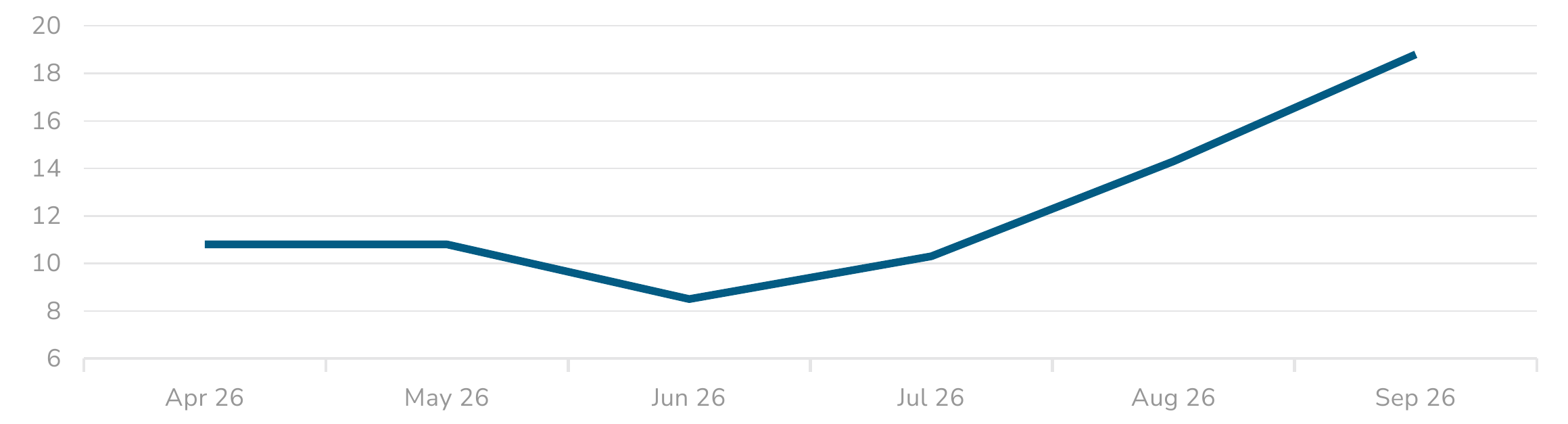
Futures markets point to a high probability of an ECB hike in December. Bunds again provided protection when equities weakened, which supports holding high-quality bonds even as energy-driven inflation keeps the ECB cautious.
08 REGIONAL SCORECARD
A shared energy shock, with very different equity results
Cross-region equity returns %, October 2026 price return
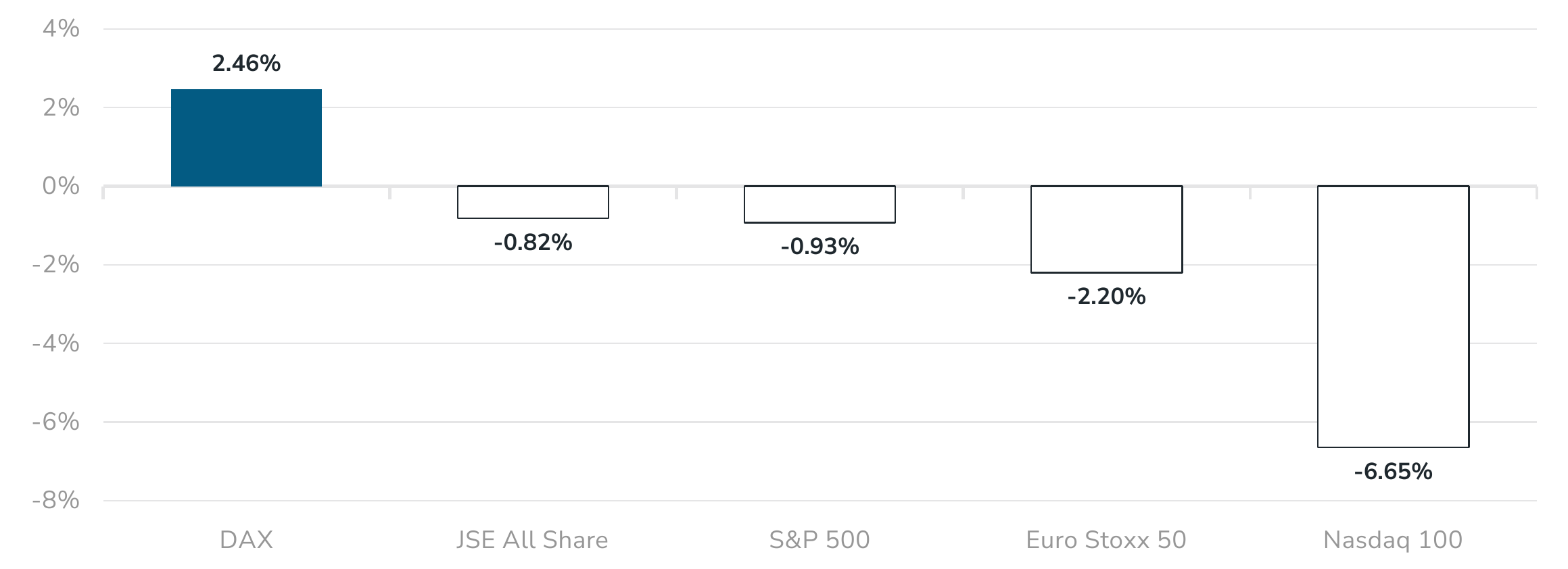
Source: Douglas Investments research and LSEG. Price returns in local currency, 30 September to 30 October 2026 closes. The Fed and the ECB held rates in October; the SARB did not meet.
October’s data shows one shock playing out differently across regions. The United States combines strong output with softer hiring, above-target inflation and a divided Fed.
The euro area has the highest headline inflation of the three regions and slowing growth, with France contracting. South Africa is improving relative to the others, with inflation below forecast and a steadier fiscal path, although growth remains weak.
October macro releases inflation, labour, policy and activity
When leadership changes this quickly, diversification across sectors and asset classes matters more than any single regional view.
09 SOUTH AFRICA
Softer inflation and steadier public finances, but a weaker rand

The SARB did not meet in October, and the repo rate remains at 7.25%. September CPI rose to 4.5% from 4.4%, below the 4.7% consensus, while core inflation eased to 4.0% from 4.1%. Transport accounted for about a third of headline inflation, and producer inflation rose to 6.2% from 5.0%. After a record fuel price in October, the next reading could exceed 5%, and economists are divided on whether the SARB will raise rates again on 19 November.
The fiscal outlook improved. The 21 October MTBPS projected a consolidated deficit of 3.9% of GDP for 2026/27, with debt stabilising and then declining, although it lowered 2026 growth to 1.2%. The rand weakened about 1.2% to 16.61, mostly on 1 October, and the JSE All Share eased 0.82%. The 2035 bond rallied, trading near 8.53% on 30 October compared with 8.73% at the end of September.


10 POSITIONING
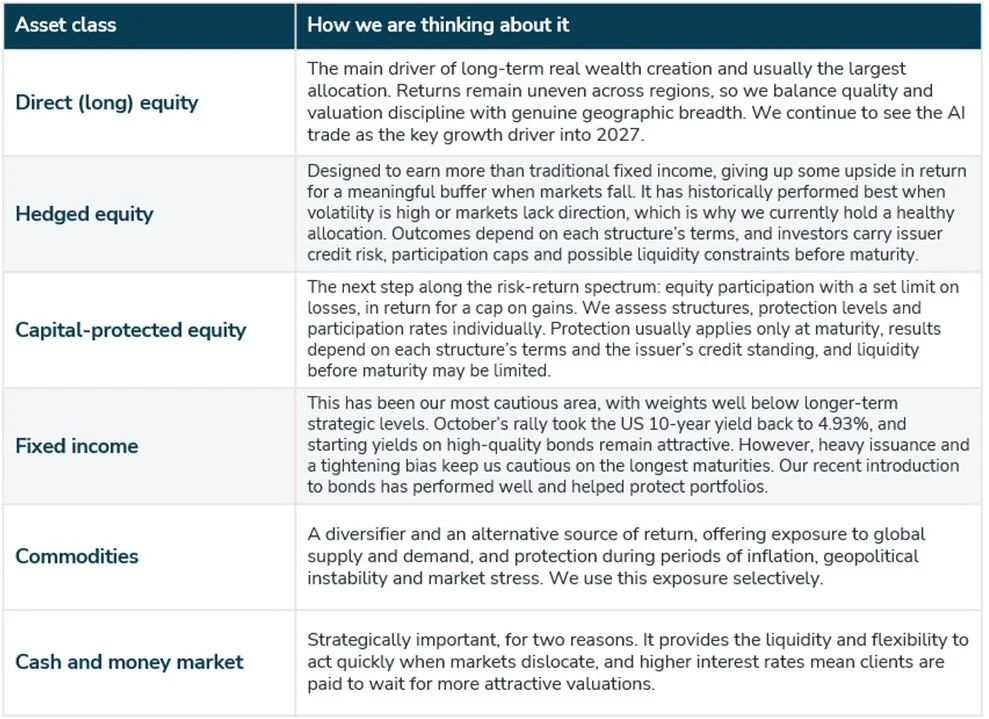
Taking part in growth while staying mindful of risk
Our house view remains positive, with a measured allocation to growth assets, and the framework below is strategic rather than a response to any single month. October added to our observations without changing our direction: central banks paused while keeping a tightening bias, long-term yields fell, and equity leadership moved away from AI-related technology. Each client’s weightings are tailored to their objectives, risk tolerance, liquidity needs and time horizon.
11 OUTLOOK
Rates on hold, not yet falling
In October, the market’s focus moved from how far central banks will raise rates to whether the return on AI investment supports current valuations. Policy was on hold: the Fed held at 3.75%–4.00% with two votes for a hike, the ECB held at 2.50% after discussing one, and the SARB did not meet. The data gave reasons for both caution and patience. US payrolls rose only 29,000 in September and unemployment rose to 4.2%, while third-quarter GDP grew 3.4% annualised. Inflation continued to rise, with US CPI at 3.7% and euro-area inflation at a three-year high of 3.8%, while South Africa’s 4.5% was below forecast.
Markets saw volatility. The Nasdaq 100 fell 6.65% as Meta’s spending plans and results from Amazon and Intel raised questions about AI returns, while the equal-weighted S&P 500 rose 4.9% and the DAX 2.46%. Bonds rallied: the US 10-year yield fell 36 basis points to 4.93% and the Bund 24 basis points to 3.34%. This reflected softer hiring and demand for safety rather than easing inflation, with Brent closing the month near $113 a barrel.
We enter November with central banks on hold but leaning towards tighter policy, inflation still driven by energy, and equity leadership less secure. The United States combines strong output with softer hiring; the euro area faces the highest inflation of the three regions and slowing growth; and South Africa has better inflation and fiscal news, but a currency exposed to global risk. In our view, the main risk is that inflation prompts a December hike just as AI-related earnings disappoint.