
Labour cools, inflation diverges, yields stay elevated - August 2026
01 MACRO OVERVIEW
A month decided by data, not by central banks
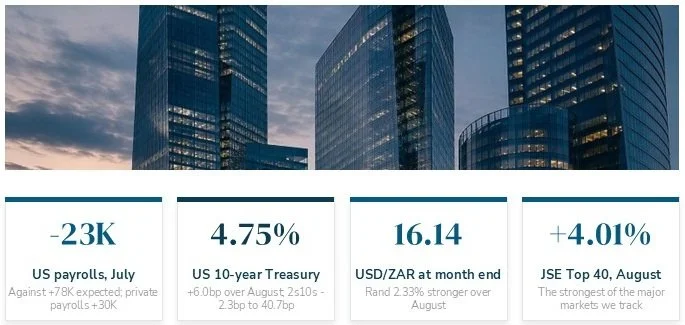
No scheduled policy decision fell within the month at the Federal Reserve, the ECB, the Bank of England or the SARB, so the regime was set by data. The clearest signal was a slowing US labour market: July non-farm payrolls fell 23,000 against a +78,000 consensus, private payrolls rose only 30,000 against +80,000 expected, and a benchmark revision of -79,000 points the same way. Unemployment nonetheless eased to 4.1%.
The inflation picture was uneven rather than uniform. Underlying US inflation moderated, although headline inflation remained elevated at 3.4% with core at 2.5%. Euro-area inflation stayed above target at 2.9%, while South African inflation slowed from 5.0% to 4.3%. Consumption was the common soft spot: US retail sales fell 0.6% month on month and euro-area sales 0.3%.
Markets only partly confirmed a softer policy path. The dollar index eased 0.4% and EUR/USD rose 0.95%, yet the US 10-year yield rose 6.0 basis points to 4.746% and the two-year rose 8.3 basis points. That combination is consistent with concerns regarding Treasury supply, term premium and inflation expectations rather than with improving growth expectations.
Softer labour data alongside elevated headline inflation is a more ambiguous mix than either signal read alone, and long yields have not yet followed the labour market lower.
02 MARKET PERFORMANCE
Equities held their nerve; strength in SA
Developed-market equity arc August 2026, rebased to 100 at 3 August
Source: LSEG. Unless otherwise stated, equity index returns are price returns in local currency terms.
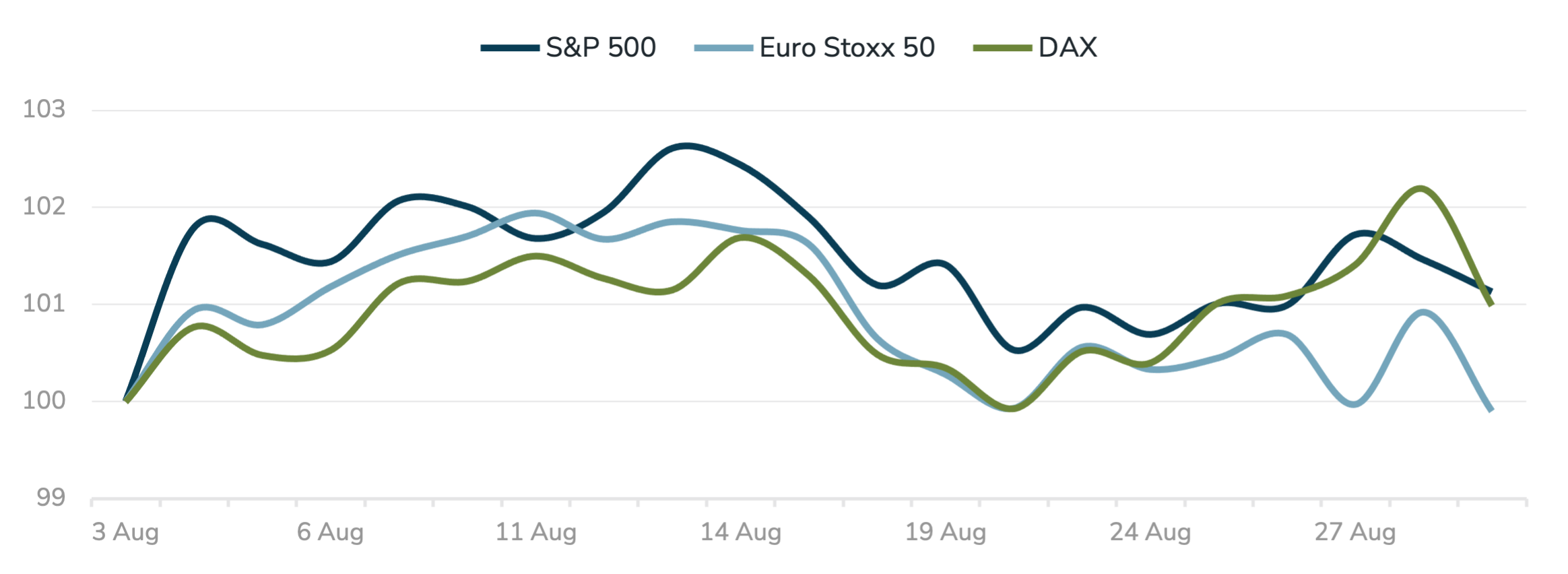
The month divided into three phases. Early August was risk-tentative, consistent with soft US labour data setting the tone. Mid-month brought the high-water mark, which appears to reflect US inflation data — headline CPI remained elevated at 3.4% while core moderated to 2.5% — alongside cooling South African inflation; the S&P 500 peaked around 13 August. The final week was rates-led, with higher Bund and Treasury yields consistent with the softer tone in European equities into month-end.
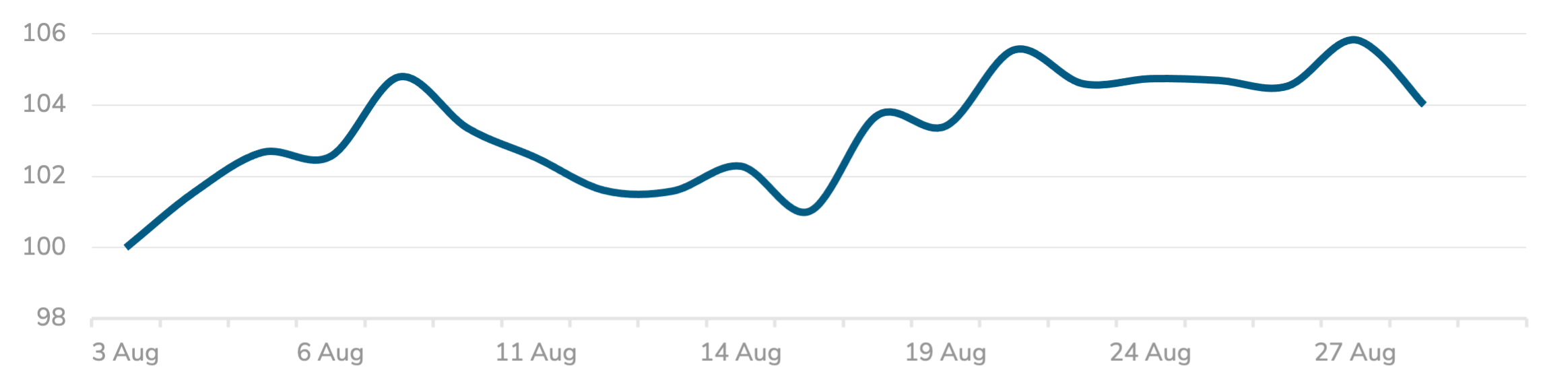
The headline outcomes were modest in the developed markets and decisive in South Africa. The S&P 500 gained 1.13% and the DAX 1.0%, while the Euro Stoxx 50 finished fractionally lower at -0.1%. The JSE Top 40 rose 4.01%, the strongest August return of the markets shown, which may reflect a firmer rand and a supportive commodity backdrop.
JSE Top 40 August 2026, rebased to 100 at 3 August
Source: LSEG. Unless otherwise stated, equity index returns are price returns in local currency terms.
The Euro Stoxx 50 is up 19.96% over one year and 10.86% for the year to date, while the JSE All-Share has gained 14.16% over one year but only 0.37% year to date, and sits about 9.5% below its February 2026 high. One possible explanation is rand strength, which reduces the rand value of commodity and rand-hedge earnings and may weigh on the resource-heavy index. The S&P 500 remains the strongest performer year to date, gaining 12.3%.
The discount rate has risen alongside those returns. The US 10-year real yield has moved from 1.82% a year ago to 2.44%, and the nominal 10-year sits at a 52-week high. Equities appear to have absorbed that move by compressing their equity risk premium: the August source data place it at 3.26%, which suggests a thinner cushion versus bonds than a year ago.
When real yields sit near the upper end of their range, the return equities must earn to justify their premium rises with them. This is not a new dynamic, but August is consistent with it.
The month’s downside surprises cluster in labour demand and household consumption rather than in prices. July non-farm payrolls fell 23,000 against a consensus of +78,000, private payrolls rose 30,000 against +80,000 expected, and retail sales fell 0.6% where a 0.2% rise was expected. A preliminary annual benchmark revision of -79,000 to prior payrolls points in the same direction, although revisions are not a consensus surprise and are shown separately from the series above.
NOTE: The measures are not directly comparable. Payroll surprises are in thousands of jobs, retail sales and producer prices in percentage points, and PMIs in index points.
The pattern is not confined to the United States, and it was not universal. Euro-area retail sales missed by half a percentage point and the UK manufacturing PMI came in 0.9 points below consensus at 51.9, while South African producer prices and retail sales also fell short. Against that, the US unemployment rate surprised favourably at 4.1% against 4.3% expected and UK GDP beat by 0.2 percentage points, so the month is better described as several material downside misses than as a uniformly weak data flow.
Downside misses concentrated in labour and consumption, with underlying inflation moderating, are consistent with a slowing economy rather than evidence of a contraction under way.
The dollar softened alongside a slowing US labour market, which suggests some repricing of the expected policy path. The dollar index fell 0.4%, EUR/USD rose 0.95% to about 1.162, and the rand strengthened 2.33% to 16.14 against the dollar. On its own, that is consistent with the currency market reflecting a relative-softening story in the United States.
Bond yields did not follow the softer signal from labour and currency markets. The US 10-year rose 6.0 basis points to 4.746%, the two-year rose 8.3 basis points and the 2s10s spread narrowed 2.3 basis points to 40.7 basis points — a modest bear flattening. The German 10-year Bund sold off harder, rising about 17 basis points to 3.32%, as the market appeared to weigh a firmer European policy stance. The combination is consistent with concerns regarding Treasury supply, term premium and inflation expectations rather than with improving growth expectations.
For a rand-based investor with USD investments the combination cuts both ways: a stronger currency lowers the cost of imported inflation but reduces the rand value of offshore returns.
An improved real-yield cushion at the short and intermediate end may support duration taken deliberately rather than at the very long end. For equities the case appears balanced — earnings have been resilient, but demand is slowing. The principal risk is that long yields remain elevated while growth moderates.
The euro-area picture was mixed to soft rather than weak. Inflation remains above target and accelerated modestly during July, at 2.9% headline and 2.5% core, with energy prices 10.3% higher. Second-quarter GDP was confirmed at 1.0% year on year and the services PMI edged up to 52.0. Consumption was the exception: June retail sales fell 0.3% against an expected 0.2% rise, and second-quarter employment growth came in a tenth below consensus at 0.5%. The August surveys describe a two-speed economy, with services expanding and manufacturing still in contraction.
Equity outcomes diverged by index rather than by economy: the DAX gained 1.0% while the Euro Stoxx 50 ended at -0.1%. Bund yields rose about 17 basis points to 3.32% and EUR/USD gained 0.95%. Political developments and rising bond yields may have contributed to weaker European equity performance late in the month.
European equities are not obviously discounting a sharp deterioration, and the equity risk premium of 3.26% suggests a thinner cushion than a year ago, which may argue for selectivity rather than broad exposure. Bund duration offers improved carry at a twelve-month high in yield, with limited room if growth disappoints.
Read side by side, the August releases describe four distinct regimes rather than a single global one. The United States is slowing on the labour side, with underlying inflation moderating while headline inflation remains elevated and growth positive but slower.
The euro area combines inflation above target with weak demand and moderate growth. The United Kingdom shows higher inflation alongside softer activity. South Africa offers the most constructive disinflationary backdrop of the four, tempered by a weak labour market and soft consumption.
Dispersion of this kind suggests that breadth across regions remains more useful than a single directional view.
South Africa produced the most constructive combination of the four economies discussed. Headline inflation slowed from 5.0% to 4.3% in July and the whole-economy PMI held just above the expansion line at 50.3. Producer prices fell 1.0% month on month against an expected 0.2% decline; this is the monthly change in producer prices rather than annual PPI inflation, is shown as reported in the August source data and should be verified against the official Stats SA July 2026 release before circulation. Taken together, this suggests the Reserve Bank has some breathing room.
The weaknesses are on the demand and labour side. June 2026 retail sales grew only 1.6% year on year against 2.3% expected, and the second-quarter unemployment rate remained at 33.6%. The equity market nonetheless led the month, with the JSE Top 40 up 4.01%, a rally that coincided with the improving inflation picture. The rand strengthened alongside a softer US dollar and an improving domestic inflation backdrop, ending August 2.33% firmer.
Our house view remains positive but measured in our allocation to growth assets, and the framework below is strategic rather than a response to any single month. August added observations rather than a change of direction: labour demand in the United States is cooling while underlying inflation moderates, developed-market real yields sit near the top of their range, and regional dispersion remains wide. Weightings are always tailored to a client’s objectives, risk tolerance, liquidity needs and time horizon.
August shifted the central question from whether inflation would allow easing to whether the labour market may come to require it. The labour market slowed: July non-farm payrolls contracted by 23,000 against a consensus of +78,000, private payrolls added only 30,000 against a consensus of +80,000, and unemployment stood at 4.1%, with a preliminary benchmark revision of -79,000 reducing previously reported payrolls. Underlying inflation moderated, with core CPI at 2.5%, while headline inflation remained elevated at 3.4% year on year and +0.1% month on month. Second-quarter GDP of 1.5% annualised, following 2.1% in the first quarter, indicates that growth remained positive but moderated during the quarter, which suggests a slowdown rather than a contraction.
Yields rose despite softer activity data. The US 10-year rose 6.0 basis points to 4.746%, a 52-week high, and the Bund rose about 17 basis points to 3.32%, even as the dollar softened 0.4%. The combination is consistent with concerns regarding Treasury supply, term premium and inflation expectations rather than with improving growth expectations. US retail sales fell 0.6% month on month, adding to the softer demand picture. The practical consequence may be a more useful real-yield cushion in intermediate bonds, and an equity market that has a higher bar to clear to justify its premium.
Regionally, the spread remains wide. South Africa offered the most constructive disinflationary backdrop, tempered by a weak labour market and soft demand; the euro area combines inflation above target at 2.9% with weak consumption and a thinner equity risk premium; the United States is slowing, with earnings still resilient. The principal risk, in our view, is that long yields remain elevated while growth moderates, which would tend to pressure duration and equity valuations together.